
Demurrage and detention lines are among the most disputed on any carrier invoice. They are also among the most common. Your customers audit you, but nobody audits your carriers. This article gives you a practical, accurate method for how to dispute demurrage charges on a carrier invoice, what the Federal Maritime Commission (FMC) billing rule requires, what a 2025 court decision changed, and what evidence wins. For a complete overview of the process, see the complete guide to invoice matching.
The short answer
To dispute a demurrage and detention (D&D) invoice, you need evidence and you must act inside the dispute window. First, check the free time you were entitled to, when the clock legitimately started, and whose delay it was. Under the FMC rule governing US trades, you must request mitigation, a refund, or a waiver within the time the invoice allows (at least 30 calendar days). Send the request in writing, with your evidence attached. A successful detention and demurrage dispute is not complete until the credit note arrives and is applied to the job. Track the dispute from submission to resolution.
Demurrage and detention in two paragraphs
Demurrage is generally a charge assessed for a container that remains at a marine terminal beyond the allotted free time. For imports, the clock typically runs from when the container is discharged until it gates out of the terminal. For exports, it may run from gate-in until the container is loaded onto the vessel.
Detention is a charge for keeping the carrier’s container outside the terminal beyond the free time. For imports, this clock usually runs from when the full container gates out until the empty container is returned to the carrier's designated depot. The terms, triggers, and the way the free time clock is calculated vary significantly by carrier, port, and tariff. For full definitions, see the LogiTrack glossary.
How big the D&D bill is
Detention and demurrage charges are a significant cost centre for shippers and a major revenue stream for carriers. Your finance team sees the individual lines, but the aggregate figures show the scale of the problem.
The five-year total
According to the FMC, the nine ocean carriers it monitors collected roughly $15.4 billion in D&D charges between 1 April 2020 and 31 March 2025. This figure underscores how consistently these charges are applied across the industry.
The collection gap
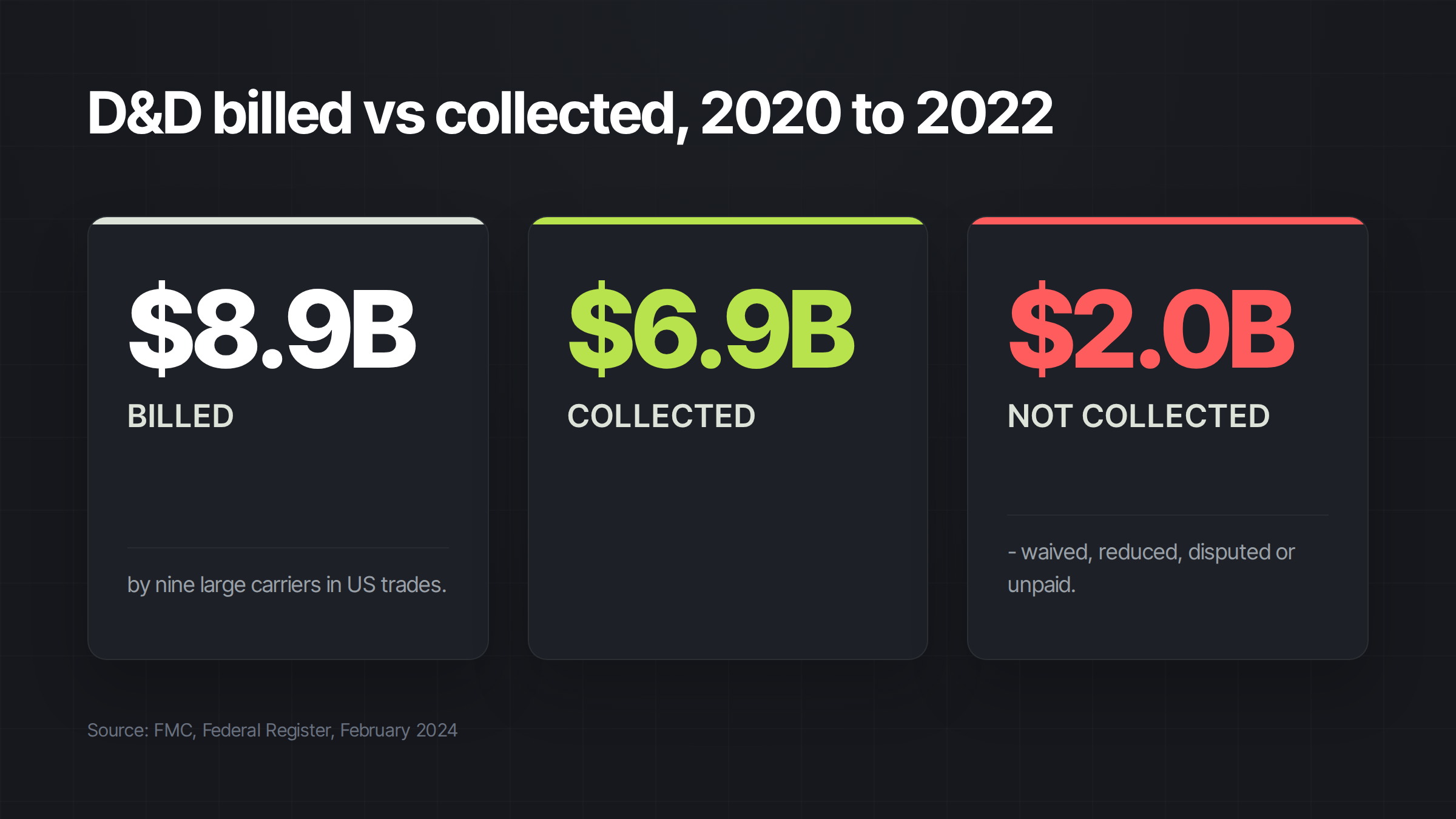
The billing numbers also reveal a significant gap. In its February 2024 final rule, the FMC noted that over a roughly two-year period from 2020 to 2022, those same carriers billed about $8.9 billion in D&D and collected about $6.9 billion (Federal Register). The remaining $2 billion—roughly a fifth of the total billed—went uncollected for reasons including being waived, reduced, disputed, or unpaid.
Not all of that gap is disputes, but it shows D&D bills are not settled at face value. A disciplined dispute process is a core financial control. To see how much incorrect D&D charges could be affecting your own bottom line, calculate what the leak costs.
What the FMC billing rule requires
For US ocean trades, the FMC’s final rule on Detention and Demurrage Billing Practices (46 CFR part 541) established clear rights and obligations for billing parties and billed parties. Most provisions took effect on 28 May 2024, creating a new standard for how to dispute demurrage charges.
The 30-day issuance deadline
The FMC detention and demurrage rule sets a strict timeline for issuing invoices. Vessel-operating common carriers (VOCCs) and marine terminal operators (MTOs) must issue D&D invoices within 30 calendar days of the date the charges were last incurred. Non-vessel-operating common carriers (NVOCCs) must issue their D&D invoices within 30 calendar days of receiving the invoice from the underlying carrier.
Required invoice information
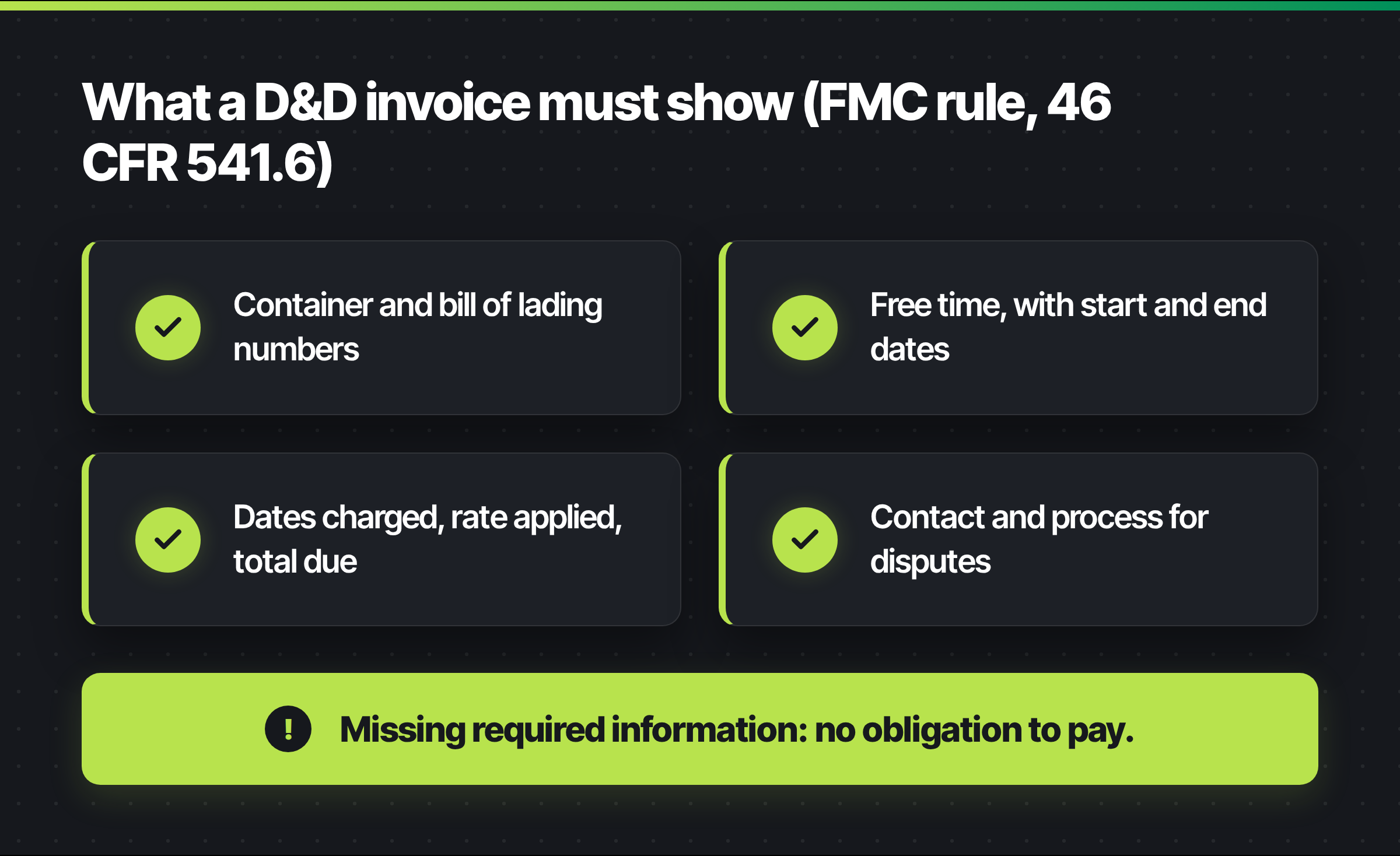
Section 541.6 of the rule sets out what an invoice must contain. The FMC states that failing to include this information eliminates any obligation for the billed party to pay. Key required fields include:
- Container number and Bill of Lading number
- Container availability date (for imports) or earliest return date (for exports)
- Allowed free time, and the start and end dates
- The applicable tariff rule or service contract provision
- The specific dates charged, the rate applied and the total amount due
- Contact information for questions and disputes
Dispute and resolution windows
The rule gives the billed party a defined window to act. You have at least 30 calendar days from the invoice issuance date to request fee mitigation, a refund, or a waiver. Once a timely request is made, the billing party must attempt to resolve the detention and demurrage dispute within 30 calendar days, unless both parties agree to a longer period. All points are sourced from the FMC's guidance on its final rule.
What the 2025 court decision changed
A common misreading of a 2025 court case has led some to believe the FMC's billing protections were eliminated. This is incorrect. The ruling was narrow and left the most important parts of the rule intact.
Section 541.4 set aside
On 23 September 2025, the US Court of Appeals for the D.C. Circuit set aside a single section of the rule: 46 CFR § 541.4. This section specified who a D&D invoice could be sent to, limiting it to the contracting party or the consignee. The court found the FMC’s reasoning on who could be billed inadequately explained.
The rest of the rule remains in effect
Following the court's decision, the FMC removed the section from the Code of Federal Regulations, effective 29 December 2025, as documented in Federal Register document 2025-23920. Crucially, the FMC has stated that apart from section 541.4, the rest of the rule remains in effect. In an announcement on its website, the FMC confirmed that the protections on accurate invoice information and the 30-day issuance deadline still stand, and that failing to meet these requirements still eliminates the obligation to pay (FMC).
The takeaway: The 2025 court ruling changed who can be billed, not the core protections regarding invoice content and timing. A late or incomplete D&D invoice still carries no obligation to pay under the FMC rule.
The evidence that wins a dispute
A successful carrier billing dispute is forensic. It is built on a foundation of evidence that proves the charge is incorrect, invalid, or unreasonable. When you learn how to dispute demurrage charges, you learn how to build a case file. Here is the evidence that wins.
1. Free time entitlement
Do not rely on a system default. Your evidence is the document that grants the free time: your service contract, the carrier's published tariff for that trade, or a specific booking confirmation. The dispute must show what you were entitled to, not what the carrier’s system assumed.
2. The clock's legitimate start
The clock does not start when the vessel arrives. It starts when the container is actually available for your action. Reconstruct the timeline with evidence:
- Container availability notice: The official notification from the terminal or carrier.
- Customs release: A screenshot or EDI message showing the container is cleared.
- Holds: Evidence of any carrier, terminal, or government holds that prevented pickup.
- Gate-in/gate-out records: The terminal's official timestamps for container movements.
3. Event history and responsibility for delay
If a delay was not your fault, you should not pay for it. Collect evidence of events that prevented you from picking up or returning the container on time. This includes:
- No return appointments: Screenshots from the terminal appointment system showing no available slots.
- Terminal closures: Official notices of closures for holidays, weather, or labor issues.
- Changed return location: Emails or system messages from the carrier directing the empty to a different, more distant, or closed depot.
4. The invoice itself
The demurrage invoice can be its own best evidence. Under the FMC rule, an invoice issued more than 30 days after the last charge was incurred carries no obligation to pay. Likewise, an invoice missing required information—like the container availability date or dispute instructions—eliminates your obligation to pay. Check the issuance date and content carefully. Always send your dispute in writing, with all evidence attached, inside the window stated on the invoice.
After the win: the credit note
Winning a dispute is a milestone, not the finish line. The money is not back in your pocket until the credit note is received, matched, and posted. A disciplined follow-through is essential for turning a "win" into actual savings.
Track open disputes to closure
Maintain a simple log of all open disputes. For each, track the invoice number, amount, date sent, and the date a response is due. This creates accountability and ensures no approved waiver is forgotten by the carrier's accounting department. A won dispute is only money once the credit note arrives and is applied.
Match the credit to the job
When a credit note arrives, it must be matched back to the original invoice line and the specific job file. This step is critical for accurate job costing and vendor invoice reconciliation. Without this link, the credit might be posted to a general account, leaving the job file showing an inflated cost and an incorrect margin. This process is especially important for costs that arrive late, ensuring they are routed for re-billing or correctly accrued, not absorbed.
Verify the amount
Check that the credit amount matches the disputed amount. If there is a partial credit, ensure the reason is documented and accepted. Look for discrepancies caused by tax calculations (like GST on demurrage) or currency conversions, and ensure the final balance on the supplier account is correct.
Where Reconciler AI fits
Managing D&D disputes manually is a time-consuming, detail-oriented task that often falls through the cracks. This is where a dedicated reconciliation workflow provides a structural advantage.
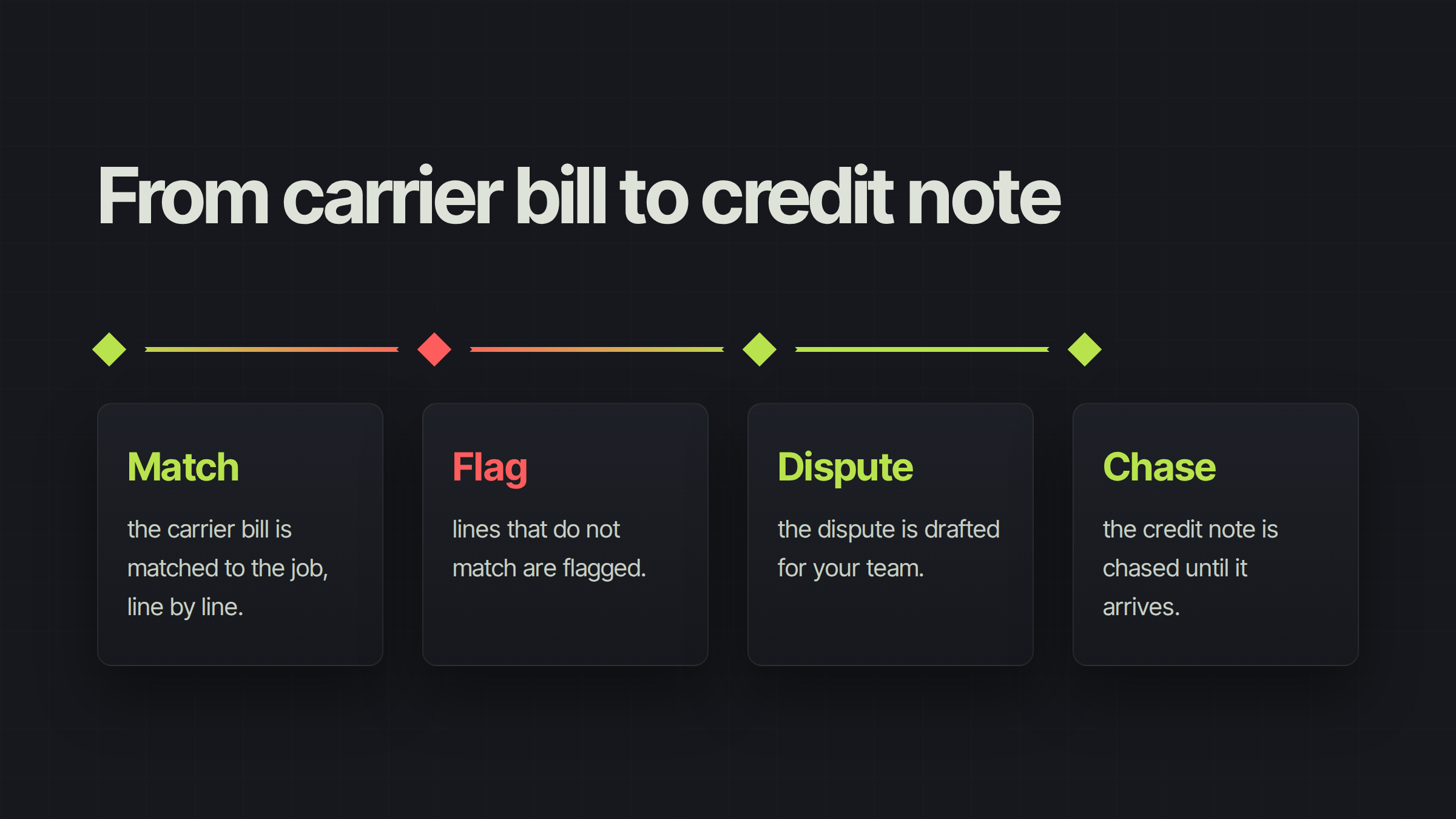
Reconciler AI by FreighAI is built for this. It reads a carrier bill and matches it back to its job, checking it line by line before it is booked. When a line does not match what the job expected, it flags the variance.
From there, Reconciler AI drafts the dispute on the wrong carrier or agent invoice and chases the credit note until it arrives. This systematic follow-up is a key difference between a match desk compared with freight audit and payment services. It ensures that a won dispute translates into a recovered cost. Crucially, every message a customer sees waits for a person, who can edit, approve, or reject it. An approved message goes out in their own name, keeping your team in full control of supplier relationships.
The platform works alongside your existing systems. Your accruals, bank reconciliation, and statutory books stay in your accounting system. Reconciler AI does the checking before you pay. To see this in action, learn how the desk works.
With the matching and the chasing handled, your team can enforce your rights under the FMC rule and your contracts, one invoice at a time. Ready to see it live? Watch an invoice matched live.
Frequently Asked Questions
How long do I have to dispute a demurrage invoice?
For US ocean trades covered by the FMC's billing rule (46 CFR part 541), the billing party must give you at least 30 calendar days from the invoice issuance date to request a fee mitigation, refund, or waiver. You should always check the specific deadline stated on the invoice itself, as some carriers may offer a longer window. For trades outside the US, the dispute window is governed by the carrier's tariff or your service contract.
Does a missing field on a D&D invoice mean I do not have to pay?
Yes, for invoices governed by the FMC rule. The Commission has stated that failing to include required information—such as the container availability date, allowed free time, or dispute contact information—eliminates the billed party's obligation to pay the charge. The 2025 court ruling did not change this. When disputing on these grounds, be specific about which required field is missing.
What did the 2025 court ruling on the FMC rule change?
The September 2025 D.C. Circuit court ruling was very narrow. It only set aside the section of the FMC rule that specified who a demurrage or detention invoice could be sent to (46 CFR § 541.4). It did not invalidate the rest of the rule. The requirements for invoice content (what must be on the invoice) and timing (the 30-day issuance deadline) remain fully in effect.
Does the FMC rule apply to shipments outside of US trades?
No. The FMC's Detention and Demurrage Billing Practices rule governs US ocean trades only. For shipments moving between other countries, such as from the UAE to India or within Europe, the dispute process is dictated by the carrier's contract of carriage (the bill of lading terms), their published tariff, and local laws or regulations in those jurisdictions.
What is the most important evidence for a detention and demurrage dispute?
The most critical evidence proves that a delay was outside your control or that the charge was calculated incorrectly. This includes: 1) The service contract or tariff showing your correct free time. 2) Terminal records or screenshots showing no available appointments for pickup or return. 3) Customs or carrier hold notifications that prevented you from acting. 4) The carrier's own invoice if it was issued late or is missing information required by the FMC rule.
How does Reconciler AI help with how to dispute demurrage charges?
It reads the carrier invoice and matches it to the job, line by line, before it is booked. It drafts the dispute on a wrong carrier or agent invoice and chases the credit note until it arrives. Every message a customer sees waits for a person, who can edit, approve or reject it.
Sources & References
This article draws on research and data from the following verified sources:
- Federal Maritime Commission: Detention and demurrage
- Federal Maritime Commission: FMC publishes final rule on detention and demurrage billing practices
- Federal Register, 26 February 2024: Demurrage and Detention Billing Requirements (89 FR 14330)
- Federal Maritime Commission: US Court of Appeals issues decision in case on demurrage and detention billing practices
- Federal Register document 2025-23920: Properly issued invoices provision set aside by court
- LogiTrack AI glossary: demurrage, detention and free time
From reading to watching.
Everything on this page runs live on a working match desk. Bring one week's vendor invoices and watch every line meet its job file.
Book the working sessionKEEP READING