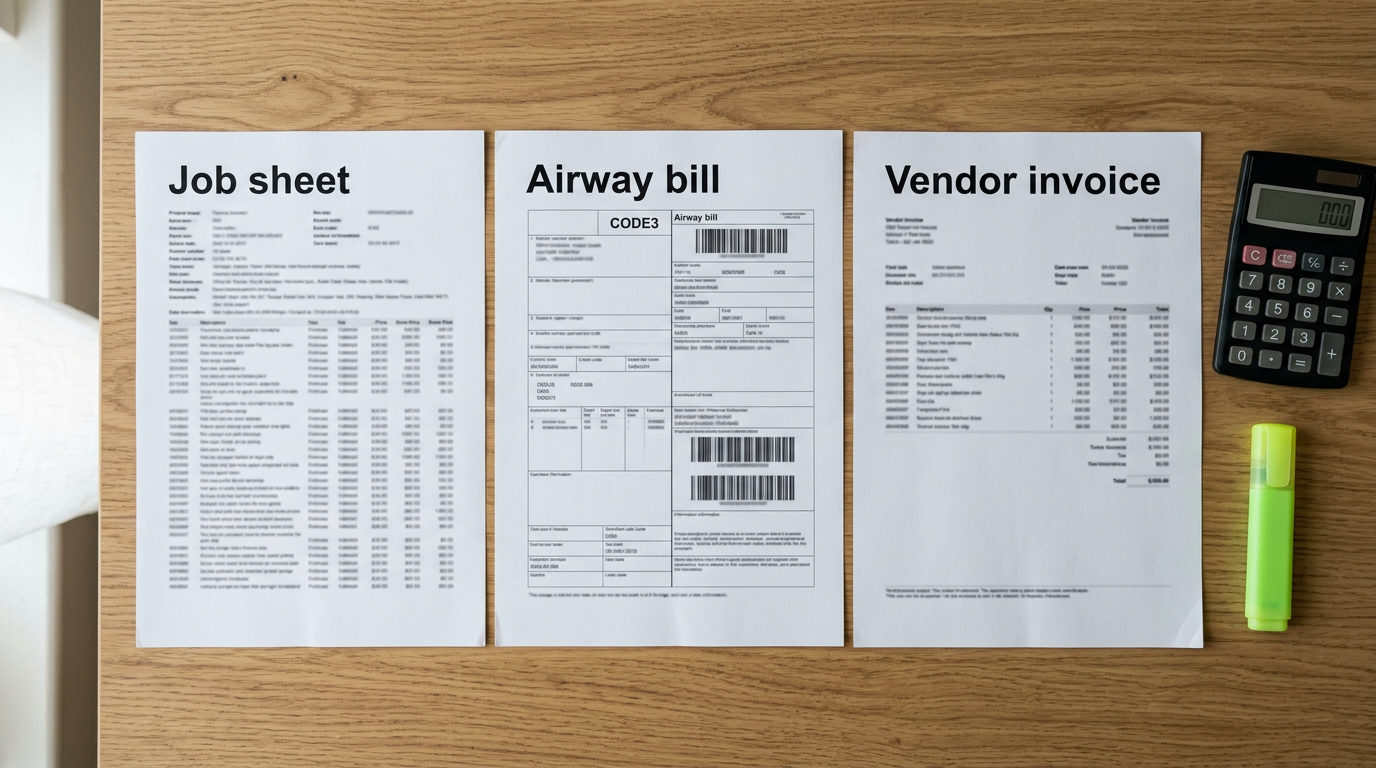
Your customers audit you, but who audits your carriers? The same surcharge can turn up on more than one bill for a single airway bill, and your accounts payable team is left to find out why. The standard control for this—three-way matching in accounts payable—seems to break down for freight forwarders because one of its core documents, the purchase order, rarely exists. But the control isn’t broken; it has been misapplied.
This article explains how to rebuild the match around the documents that do exist in forwarding: the job file’s buy rate, the shipment’s physical evidence, and the carrier’s invoice. It is a forensic, line-by-line process that stops overpayments before they happen. For a complete overview of the process, see the complete guide to freight invoice matching.
What is three-way matching in accounts payable?
Three-way matching in accounts payable is an internal accounting control that compares three documents—the supplier invoice, the purchase order (PO), and the goods receipt note—before approving an invoice for payment. The invoice is paid only when the details across all three documents agree within an acceptable tolerance.
The Textbook Definition and Its Purpose
The classic 3 way match is a cornerstone of accounts payable procedure. Each document serves a distinct purpose:
- The Purchase Order (PO): Confirms what your company agreed to buy, from which supplier, at what price, and in what quantity. It is the record of commercial intent.
- The Goods Receipt Note (GRN): Confirms what your company physically received. It is the evidence of delivery.
- The Supplier Invoice: Confirms what the supplier is asking to be paid.
The purpose of this control is to prevent common payment errors, such as paying for goods that were never ordered, paying for quantities that were never received, or paying an incorrect price. According to documentation from Microsoft, the process checks invoice price information against the PO and invoice quantity information against product receipts. An invoice that fails this check is flagged as a discrepancy, preventing automatic payment.
Two-Way and Four-Way Matching Explained
While what is 3-way matching in accounts payable is the most common question, two other variants exist. Two-way matching compares only the invoice and the purchase order, a faster but less secure process. Four-way matching adds a fourth document—an inspection or quality acceptance report—to the mix, which is common in manufacturing where quality standards are critical. According to Oracle, this requires PO, receipt, and invoice quantities to match within tolerance before payment.
Why forwarding has no purchase order
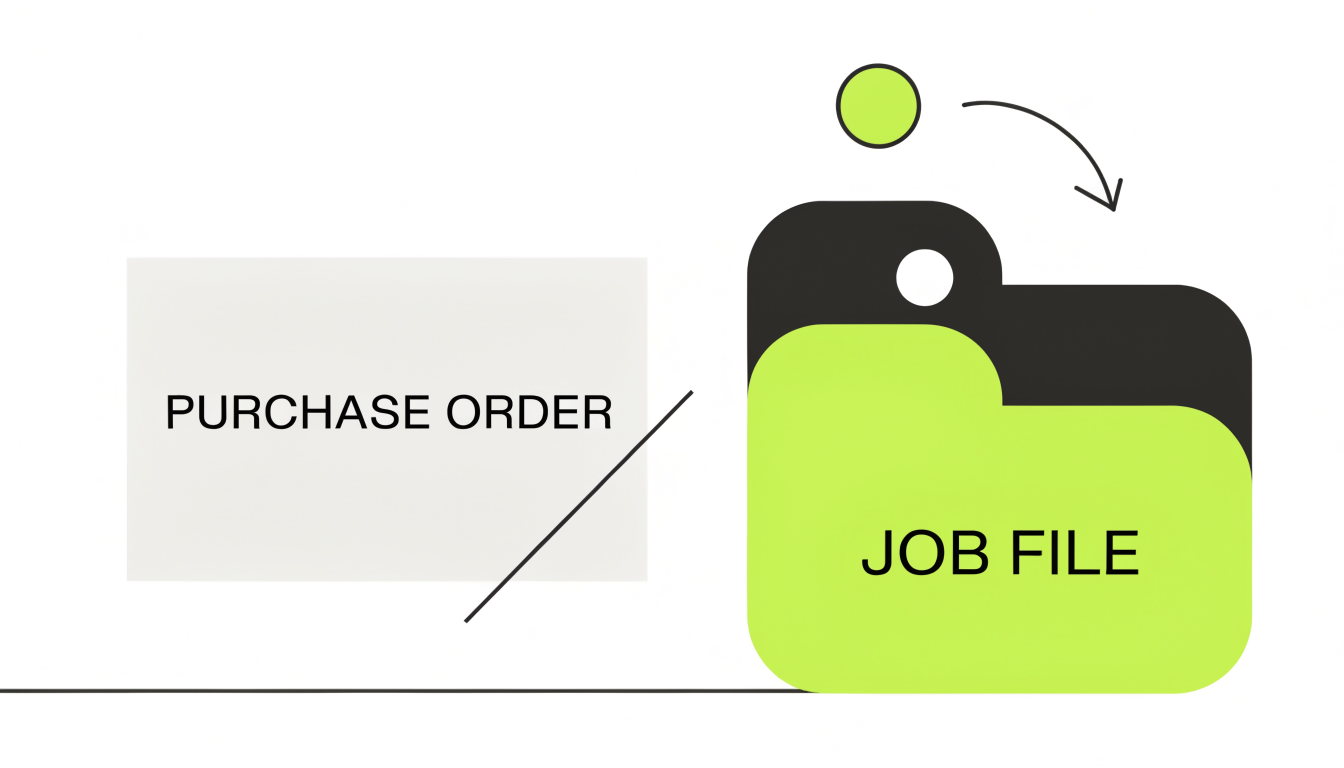
The textbook three way match process relies on a purchase order, but freight forwarders rarely raise a formal PO for every carrier, co-loader, or agent service. This isn't a failure of process; it's a reflection of the business model.
The Purchase is Shipment-Specific
A forwarder buys freight capacity on a per-job basis. The cost is determined by a unique combination of factors: the trade lane (e.g., Nhava Sheva to Felixstowe), the carrier, the equipment (e.g., 40-foot container), the chargeable weight, and the spot rate or contract rate available at the moment of booking. As IATA explains, air cargo rates can be bilaterally agreed upon and confidential, negotiated for a single shipment. Raising a PO for every single booking would be an administrative bottleneck that adds no value.
The Agreed Cost Lives on the Job File
Instead of a PO, the commercial authority for the cost lives on the shipment’s job file. This is where the operations or pricing team records the agreed buy rate from a carrier’s quote, rate sheet, or booking confirmation. In accounting terms, this expected cost is recorded as a job-based accrual. This allows the forwarder to estimate the job’s profitability long before the final supplier invoice arrives. The job file holds the truth of what was agreed.
Carrier Invoices Arrive Late
Supplier invoices from airlines, shipping lines, and agents are notorious for being costs that arrive late. An invoice may not be issued until after the vessel sails, after the cargo is delivered, or after the final weight is confirmed. Surcharges for fuel, security, or terminal handling can be applied after the initial booking. This timing gap makes the job file’s accrual essential for financial visibility, but it also means the final invoice must be rigorously checked against that original accrual.
The forwarder's three-way match
Since a conventional PO doesn't exist, a forwarder must adapt the 3 way po matching logic. The control is rebuilt by substituting the PO and the goods receipt with documents that are native to freight forwarding. This creates a practical, robust version of three-way matching in accounts payable.
The rule becomes: Pay only what the job agreed, for what the evidence shows was done.
Document 1: The Job File's Accrual (The PO Substitute)
The first leg of the match is the job file. It acts as the purchase order by documenting the commercial agreement with the supplier. It must contain:
- The agreed buy rate and the basis (e.g., per kg, per container).
- The currency of the rate.
- The expected cost, recorded as an accrual in your system.
- The specific charge types included in the rate (e.g., freight, fuel).
- The correct tax treatment for the service and jurisdiction.
- A reference to the quote or rate sheet that authorized the cost.
This accrual is your financial baseline. It is the amount you expect to pay. The match begins by comparing the vendor invoice to this number.
Document 2: Shipment Evidence (The Goods Receipt Substitute)
A forwarder doesn't "receive goods" from a carrier; it receives a service. Therefore, the goods receipt is replaced by evidence that the service was performed. This shipment evidence can include:
- For air freight: The Air Waybill (AWB), showing pieces, weight, and flight details.
- For sea freight: The Bill of Lading (BOL) or Sea Waybill, confirming the container number, vessel, and sailing. According to UK government guidance, a BOL is documentary evidence that a carrier has received the goods for shipment (business.gov.uk).
- For all modes: Delivery records, proof of delivery (POD), terminal gate-in/gate-out records, or customs release documents.
This evidence proves that a specific, billable event occurred for the shipment in question.
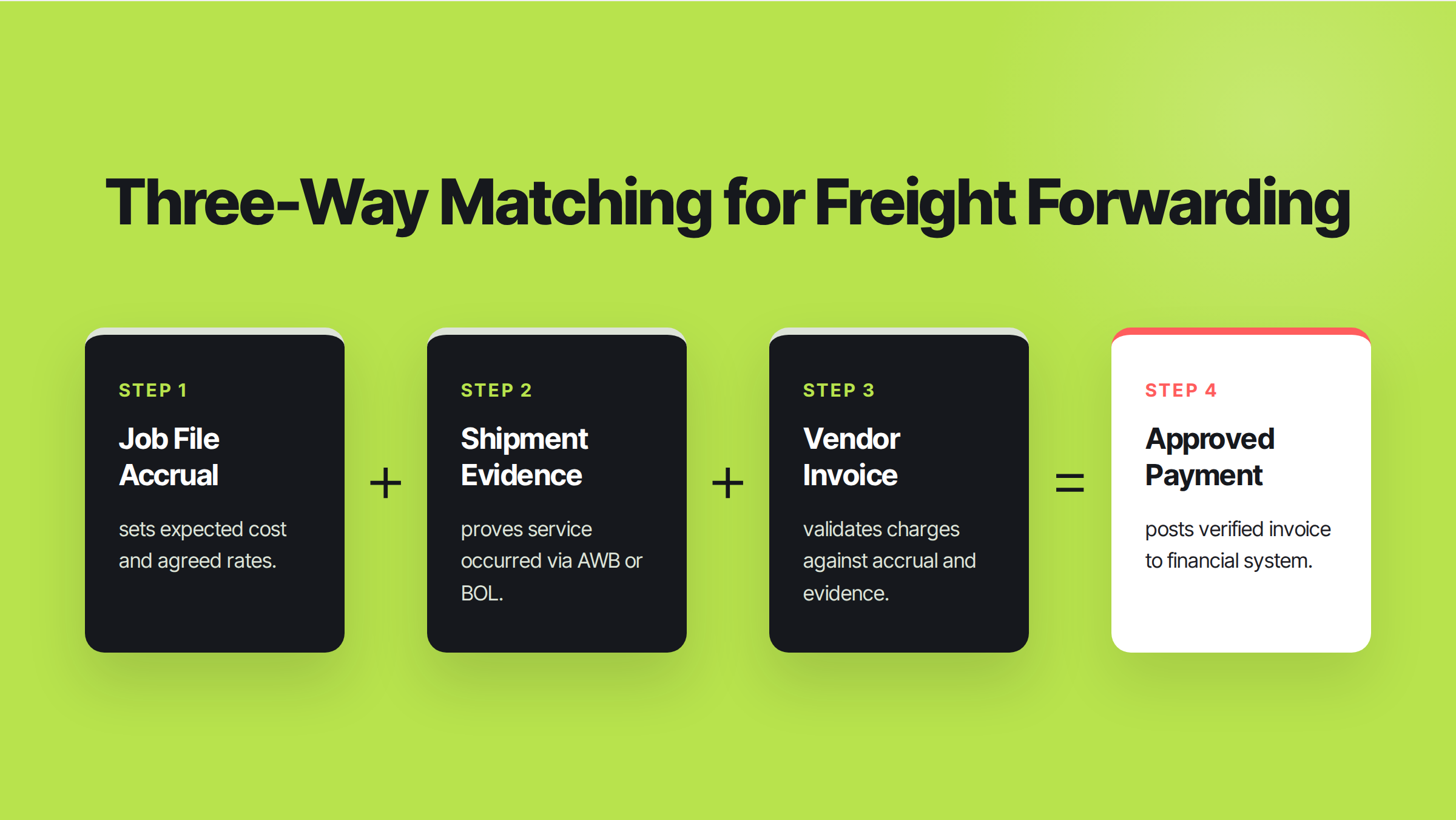
Document 3: The Vendor Invoice
The final document is the carrier, co-loader, or agent invoice. This is the claim for payment. The three way match process validates this claim by checking every line item against the job file's accrual and the shipment evidence. The invoice must reference the correct job, AWB, or BOL, and its charges must align with what was agreed and what was done.
The Role of the Accounting System
It is critical to understand that this operational match happens before the invoice is posted to your main accounting ledger. Your accounting system (e.g., Tally, QuickBooks, SAP) remains the system of record for your statutory books, bank reconciliation, and final payables. The forwarder's 3-way matching in accounting ensures that only verified, correct invoices ever make it into that system.
Variances and what to do with each
A failed match is a variance. A variance is not a problem to be ignored; it is a signal to investigate. Your AP process must have a clear workflow for holding the line, raising a dispute, and chasing a resolution.
Rate Variance
A rate variance occurs when the unit price on the invoice differs from the buy rate on the job file.
Worked Example: Your job file has an accrued air freight rate of USD 2.85 per kg for a shipment from Chennai. The airline invoice arrives billing at USD 3.10 per kg on a chargeable weight of 500 kg.
- Accrued Cost: 500 kg * $2.85/kg = $1,425.00
- Billed Cost: 500 kg * $3.10/kg = $1,550.00
- Variance: $125.00 (Unfavourable)
Action: Do not pay. Place the line item in dispute. Ask the carrier to provide the rate sheet or spot quote confirmation that authorizes the $3.10 rate. If they cannot, you are owed a credit note.
Weight Variance
This happens when the billed weight differs from the chargeable weight on the AWB or the weight used for the accrual. The chargeable weight in air freight is the greater of the actual weight and the volumetric weight, and a small change can have a large financial impact.
Action: Match the invoiced weight back to the final AWB and any carrier re-weigh slips. If the invoice uses a higher weight without evidence, dispute it.
Charges Not Agreed on the Job
Carriers often add ancillary charges for handling, documentation, or other "special" services that were not part of the original quote.
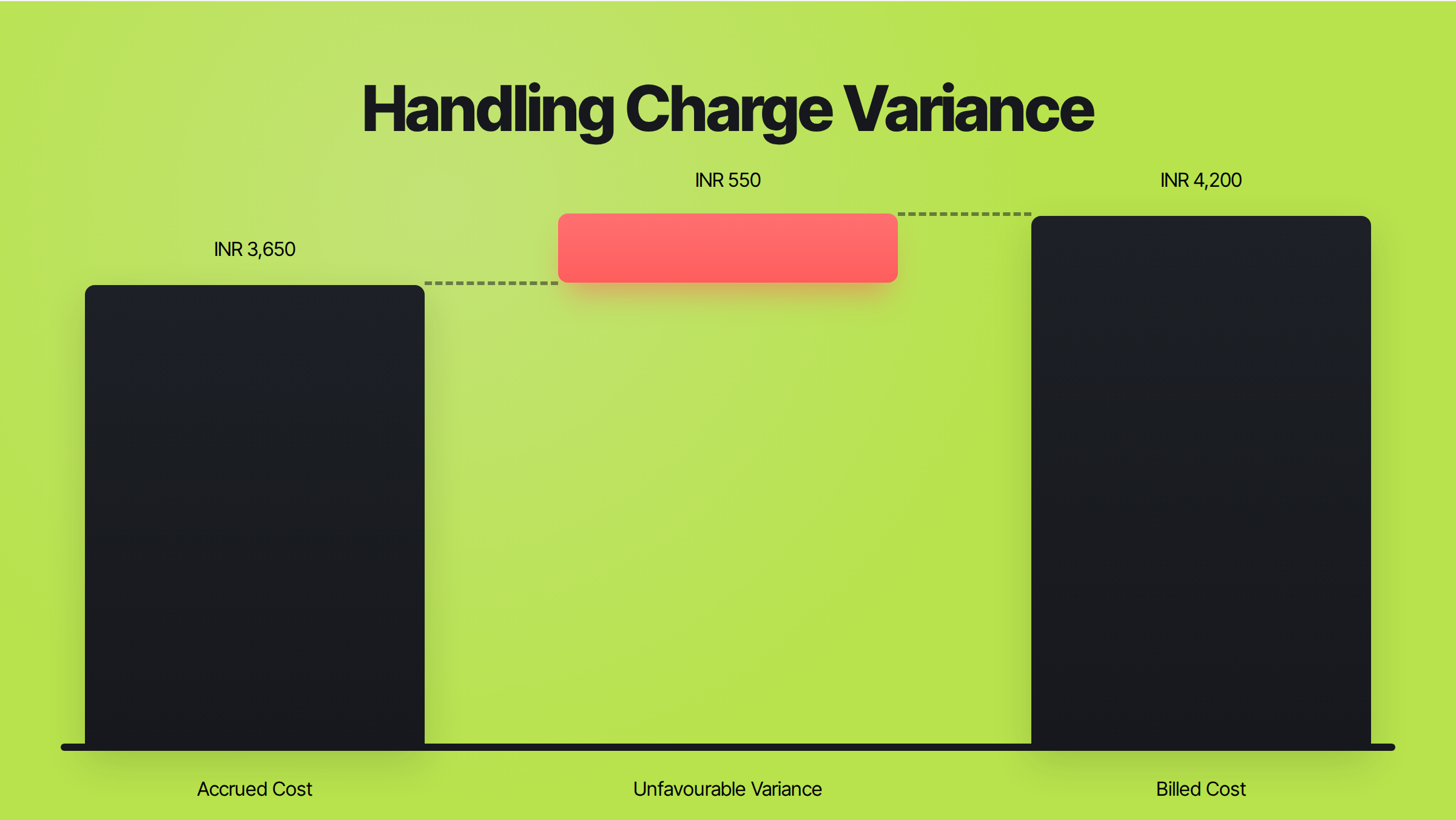
Worked Example: Your job file for a shipment out of Mundra has an accrued local handling charge of ₹3,650. The vendor invoice bills this line at ₹4,200.
- Accrued Cost: ₹3,650
- Billed Cost: ₹4,200
- Variance: ₹550 (Unfavourable)
Action: Check the original quote. Was this surcharge mentioned? Is there a tariff rule that allows it? If not, the charge is invalid. The process for disputing a carrier invoice should be initiated immediately.
Duplicate Invoices and Invoices for the Wrong Job
These are simple but costly errors. A robust three way matching process checks for duplicate invoice numbers against a specific supplier. More importantly, it checks if the AWB or BOL on an invoice has already been billed, even under a different invoice number. If an invoice for a Jebel Ali handling charge is applied to a job that never went through the UAE, it must be rejected.
TDS on Vendor Invoices in India
For forwarders in India, vendor invoice matching has an added layer of complexity: Tax Deducted at Source (TDS). Payments to contractors, including transporters, are subject to TDS under Section 194C of the Income Tax Act. A proper matching process must not only verify the gross invoice amount but also capture the correct TDS amount, ensuring the net payable to the vendor and the tax liability to the government are both recorded accurately. An incorrect gross amount leads to an incorrect TDS calculation.
Where Reconciler AI fits
Manually performing this forensic, line-by-line match across hundreds or thousands of carrier invoices is where the spreadsheet-and-email system breaks down. This is the specific problem Reconciler AI is built to solve.
It works alongside your existing accounting system to automate the forwarder's three-way match. Based on FreighAI technology, it acts as a pre-accounting validation layer.
- It reads a carrier bill and matches every airway bill back to its job, checking each charge line by line against the accrual before the invoice is booked.
- When a variance is found on a carrier or agent invoice, it drafts the dispute with the evidence attached and chases the credit note until it arrives. Every message waits for a person on your team to edit, approve, or reject it before it is sent.
- For Indian forwarders, it captures the TDS deducted on a vendor invoice, so the gross payable, the deduction, and the net payment are recorded together, cleanly.
This ensures that only correct, verified payables enter your books. Your accruals, bank reconciliation, and statutory reporting stay in your accounting system, which remains your single source of truth. The payable side of a forwarder no longer has to run on a spreadsheet. You can see what the leak costs your business or watch an invoice matched live.
Standard AP matching versus the forwarder's match
The difference between the textbook process and the forwarder’s reality is the source of truth for the "order" and the "receipt." This is why generic AP automation tools often struggle with freight forwarding payables.
A Comparison Framework
This table shows how the control points differ:
| Control Question | Standard AP Three-Way Match | Forwarder's Match (No PO) |
|---|---|---|
| What stands in for the order? | The approved purchase order. | The shipment job file with its agreed buy rate and accrual. |
| What stands in for the receipt? | A goods receipt note (GRN). | Shipment evidence (BOL, AWB, POD, terminal records). |
| When does the invoice arrive? | After goods are ordered and received. | Often weeks or months after the service, creating a reliance on accruals. |
| Where does the agreed cost live? | On the PO line item. | In the job's buy-rate record, sourced from a quote or rate sheet. |
Why PO-Centric Tools Need a Workaround
Software built around a PO-receipt-invoice workflow requires a workaround for the per-job buying model of forwarding. Teams are often forced to create "dummy" POs after the fact just to get an invoice into the system, which defeats the purpose of the control. A true solution must be built around the job file as the central anchor for all costs and revenues. You can see how this compares with other solutions in our analysis of generic AP tools compared.

Frequently Asked Questions
Can you do a three-way match without a purchase order?
Yes. This is a common requirement in industries like freight forwarding where services are bought on a per-job or per-shipment basis. In this scenario, the purchase order is replaced by another form of commercial authorization. For a forwarder, the job file, which contains the agreed-upon buy rate and the cost accrual, serves as the PO substitute. The match is then made between the job file, the shipment evidence (like a Bill of Lading), and the vendor invoice.
What is the difference between two-way and three-way matching?
The key difference is the third document: evidence of receipt. A two-way match compares only the purchase order and the supplier invoice. It confirms that the price and terms are correct but does not verify that the goods or services were actually delivered. A three-way match adds the goods receipt note (or, in forwarding, shipment evidence like an AWB or POD) to confirm delivery, providing a much stronger financial control against paying for items not received.
Who resolves a variance, operations or accounts?
The person or team that owns the commercial relationship and the job should resolve the variance. While the accounts payable team flags the discrepancy, they often lack the context to approve or reject it. The best practice is to route the variance (e.g., a rate difference or an unagreed surcharge) back to the operations or pricing team member who booked the freight. They have the rate sheets and correspondence needed to validate or dispute the charge. The resolution, with evidence, should be attached to the invoice record.
What about agents who bill by statement?
Overseas agents often bill via a monthly or bi-weekly Statement of Account (SOA) that consolidates dozens of individual charges for multiple shipments. This makes a simple invoice-to-job match difficult. The principle remains the same, but the execution changes. Each line on the statement must be unbundled and matched back to its individual job file and accrual. This process of settling an agent's statement of account is a specialized form of reconciliation that requires breaking the statement down into its constituent parts before any payment is approved.
What is the goal of 3-way matching in accounting?
The primary goal of 3-way matching in accounting is to ensure the accuracy and validity of vendor payments. It is an internal control designed to prevent overpayments, fraudulent invoices, and payments for goods or services that were not ordered or received. By systematically verifying the invoice against both the commercial agreement (the PO or job file) and the proof of delivery (the receipt or shipment evidence), a company protects its cash flow and ensures its expenses are legitimate.
How does the three way match process work with multiple currencies?
In global freight forwarding, a robust three way match process must handle multiple currencies. The job file should record the buy rate in its original currency (e.g., USD). The vendor invoice may be in that same currency or a different one (e.g., EUR). The matching system should compare the amounts in the original currency to check for rate variances. Any exchange rate differences between the accrual date and the payment date should be recorded separately as a currency gain or loss, not as a supplier-side variance.
Sources & References
This article draws on research and data from the following verified sources:
From reading to watching.
Everything on this page runs live on a working match desk. Bring one week's vendor invoices and watch every line meet its job file.
Book the working sessionKEEP READING